Dinner and dance
How a company dinner and dance actually runs
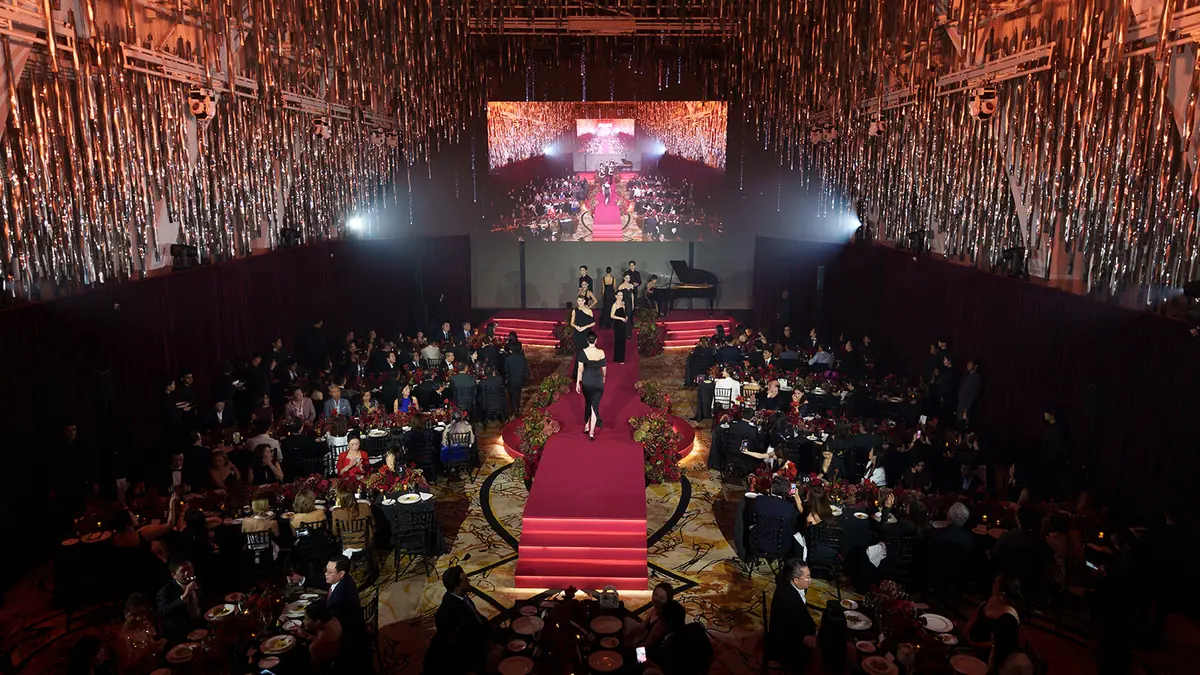
Almost nobody chooses this job. It arrives in a meeting: the date is set, the budget is roughly known, and you are the one holding it. Then you open a blank document and realise you are not sure what actually happens between guests walking in and the lights coming up.
Here is the shape underneath it. Not the invitation, not the theme. The mechanics.
The night is four hours, and only one of them is dinner
The programme most people write puts everything in a neat line: guests arrive, everyone sits, dinner is served, then the programme runs, then dancing. Almost no real night goes like that.
Guests do not arrive at the start time. They arrive across roughly an hour, in a long tail, and the last of them turn up after you wanted to begin. So the reception is not dead time to be minimised. It is a real segment with its own job: registration, a drink, photographs, and enough to look at that arriving early is not a punishment.
Then the room seats, which takes longer than anyone plans for, because people want to find their table and then find their friends and then move. Fifteen minutes is optimistic. Twenty is honest.
Dinner and the programme are not sequential. They are woven. The kitchen needs service windows and you need the room seated and quiet, and those two needs happen to align: a course goes out, people eat, plates clear, and that clearing gap is exactly when something should be happening on stage.
The dance floor gets the last stretch, and it should be a real stretch. A floor that opens at the point people are already collecting their bags is a floor that was never going to fill.
Build the shape of your night
Set your door time and how long you have the room. This is a skeleton, not a finished run sheet, but the proportions are the ones that hold.
The hour before doors is the one that matters
Everything that fails on the night was available to be found in the ninety minutes before it. Not the decor. The mechanics.
The laptop that has the deck is not the laptop that was tested. The video plays but the audio comes out of the laptop rather than the room. The emcee has version four of the script and the AV operator has version two, so a cue lands on nothing. The winner list for the lucky draw is in someone's email rather than in someone's hand.
None of these are dramatic. All of them show up as a pause on stage while somebody crouches over a cable, and that pause is the entire difference between a night that felt run and a night that felt survived.
A rehearsal is not a run-through of the fun bits. It is a test of every handover between two people.
Who owns which hour
On a night that works, four roles are live and they do not overlap.
- The banquet manager owns the food and the room. When courses go out, how many staff on the floor, where the service doors are, what time the kitchen has to close.
- The AV lead owns everything that makes a sound or a picture. Cues, mics, the deck, the playback, the lighting states.
- The emcee owns the room's attention. Not just the words, the pace: knowing when to stretch because a course is late, and when to cut because it is not.
- The event manager owns the run sheet and the decisions. Somebody has to be the person who says the awards move up ten minutes, and that person cannot also be plating dessert.
The role that should not be live is yours. If the person from HR who was handed this job is the one carrying the winner list to the stage, the night is being held together by the one person who is also supposed to be a guest at it.
Three things that go wrong
The programme was written without the kitchen. This is the most common one by a distance. A run sheet built around the stage will collide with service, and then the banquet team has a choice between holding food until it is cold or walking plates through a speech. On our own run sheets the course timings go in before the programme does, and the programme is fitted around them. It feels backwards the first time you do it, and it is the single change that removes the most pain.
Nobody owns the lucky draw. It looks like the easiest segment and it is the one that most reliably runs long. Names have to be collected, verified, drawn, announced, and the prize has to physically be somewhere. Give it a named owner and a rehearsed mechanism, or it will take twenty minutes it was never given.
The dance floor opens late. Usually because everything before it ran over, and each individual overrun looked small. Ten minutes of late seating, five on a longer speech, twelve on the draw. That is nearly half an hour taken off the end of the night, and the end of the night is the part people remember.
What a quote should show you
When pricing comes back, the useful question is not what the total is. It is whether you can see what the total is made of. Venue and food, AV, stage and set, entertainment, photography, printing, manpower on the day. Each with a number against it.
A single figure is not a quote, it is a request for trust. An itemised one lets you make real decisions: fewer cameras, a smaller stage, a different band. You cannot trade anything against a number you cannot see inside.
Planning one this year
Tell us the date, the headcount and roughly what you want the night to feel like. We will come back with a shape for the evening and an itemised quote you can actually read.