Venues
Conference room rental in Singapore, and the six things the rate leaves out

The rate a venue quotes for a room is the price of the room. It is not the price of holding a conference in it, and the difference is neither hidden nor a trick. It is simply not on the page you were sent.
It is also predictable. The same short list sits outside the rate almost every time, which means the gap can be closed with questions rather than with experience.
What the rate does buy
Nearly every quoted room rate covers the room for a stated window, house tables and chairs in one agreed setup, the lighting already in the ceiling, and a house sound system with a microphone or two. Guest wifi is usually thrown in.
That is a working meeting room. It is not yet a conference with a stage, an operated screen, a speaker who needs a monitor to read from, and a room full of people who have to be fed and moved. Everything on that second list is a separate line, and the venue is not being evasive by leaving it out. If you are still comparing rooms rather than reading a quote, start from what the event has to do instead of from the rate.
The six it usually does not
Six items account for most of the surprise: rehearsal access, technician hours past the first block, power distribution, a dedicated internet line, a furniture reset between setups, and whatever happens after the hard stop. None of them is exotic. All six are free to ask about in week one and expensive to discover in week six.
Run your own quote through the list below. Tick only the lines it names in writing, in words you could point at. What is left is your list of questions.
What your quote actually names
Nine lines every conference room hire touches. Tick the ones your quote states explicitly. The reading underneath ranks the gaps by what each costs when it surfaces late, not by size.
The window is shorter than it looks
The hire window contains your build and your strike. Almost nobody reads it that way the first time. If the room is yours from 09:00 to 17:00 and the conference runs 10:00 to 16:00, the entire build has an hour and the entire teardown has an hour, and neither of those is what a build and a teardown take.
Teardown is the half that hurts, because it is the half nobody rehearses. A conference ends with people still in the room, a client who wants to talk, and a set that cannot come down until the last of them has gone. Then the room has to be back to house standard by the hour written on the contract, because there is usually a crew waiting to build somebody else's morning in it.
The number to negotiate is not when your event ends. It is when the room has to be empty.
Rehearsal is the one everybody assumes
Rehearsal access is the item most often assumed and least often included. The reason is structural rather than mean. The hire window starts on the morning of the event, so the day before belongs to whoever booked the day before, and a quote that says nothing about rehearsal is not refusing you one. It just has not sold you one.
If a speaker has never held a clicker, if a video has sound in it, if anyone walks on from a specific side, rehearsal is the difference between a run and a recovery. It is also where a run of show stops being a document and becomes something the crew has actually done once. Ask for the access while the rate is still being negotiated. At that point it is a request. After signature it is an availability problem.
What AV included means, and what a block is
In practice, AV included is the house sound system, whatever screen or LED wall the room already owns, and one or two microphones. It is rarely show lighting, a switcher, a confidence monitor for the presenter, or a person at the desk operating any of it.
That last one catches people. Technician time is sold in blocks, four hours or eight, and the block starts when the technician arrives, which is at load-in and not at doors. A day that opens with an early build and closes with a late strike outruns one block by hours, whatever length the show itself was. A block is a billing unit, not a description of your day.
Ask for all nine before the deposit. A venue that will sit through nine awkward questions is a venue you can plan around, and that is most of them. The room is then one line of the budget, and an event quote carries the rest. We work the same list on every conference we run.
The layout a kick-off needs
A kick-off with production behind it needs a stage, a screen the back row can read, and a room that moves between talks, video and table work. Choose the layout before comparing rates, because the same room holds a different number in each. Then check the venue's figure for that layout, and the screen from the back row, on a site visit.
| Suits | What it asks for | |
|---|---|---|
| Theatre | One stage, with everyone facing it | A stage, a screen sized for the back row, someone to run both |
| Cabaret | Talks that break into table work and back | More floor per person, but no reset |
| Banquet rounds | A kick-off that ends in a meal in the same room | A reset over lunch, or a second room |
| Hybrid | Any layout, with offices elsewhere watching live | A wired line, a camera position, an operator for the stream |
Rounds suit a room that has to eat, listen and get up again. At a ballroom event our team worked on, the photographs show rounds before a low stage, lights hung over the floor, and the whole room on its feet between the tables.
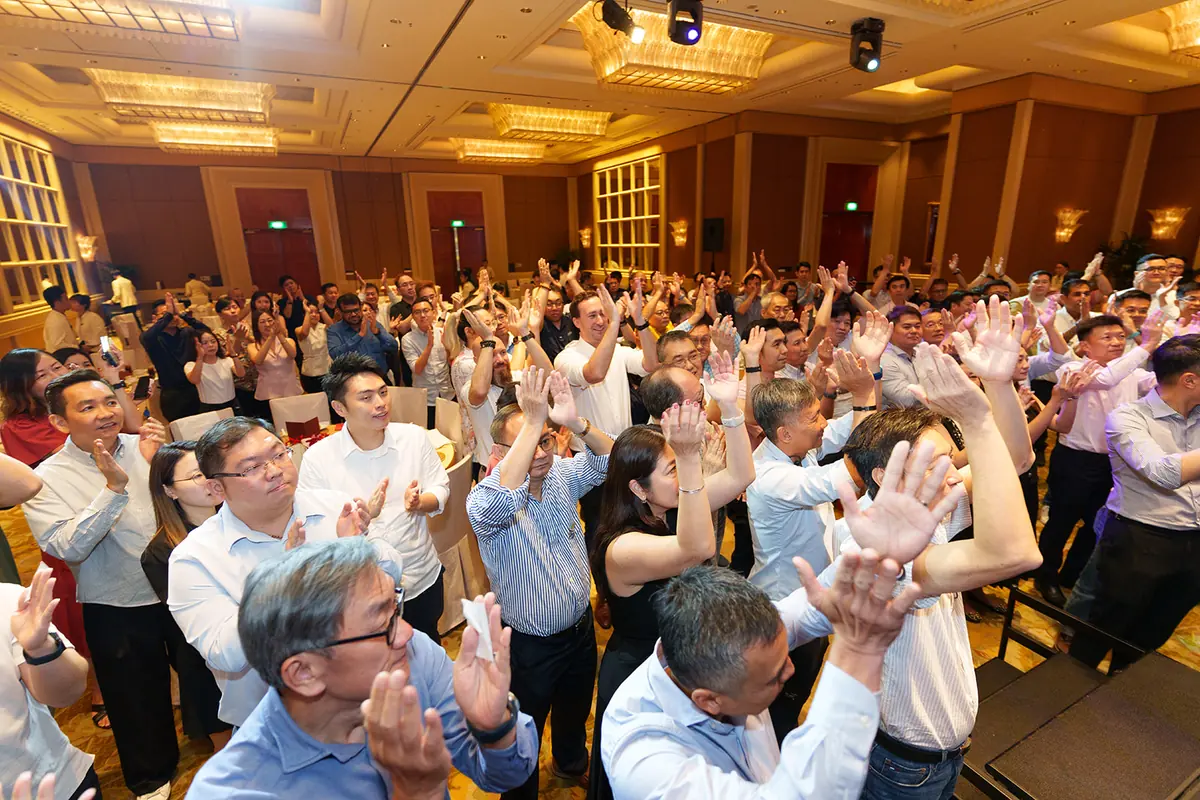
Hybrid surprises people most. The remote audience sees only what the camera sees, and loses the session when the line drops, so the guest network will not do. Put the camera on the floor plan before the rows, and give someone the job of watching the remote side while it runs.
Common questions
What does a conference room rental usually include?
Almost every quoted room rate covers the same things: the room for a stated window, house tables and chairs in one agreed setup, the lighting already in the ceiling, a house sound system with one or two microphones, and guest wifi. That is a working meeting room. It is not yet a conference with a stage, an operated screen, a rehearsed speaker and a crew, and everything in that second list is quoted separately.
Is rehearsal time included in a conference room rental?
Usually not. The hire window normally starts on the morning of the event, so the room the day before belongs to whoever booked the day before. Nothing in a standard quote says you cannot rehearse and nothing says you can. Ask for rehearsal access while the rate is still being negotiated, because at that stage it is a request, and after signature it becomes an availability problem.
Does a room hire window include set-up and teardown?
Yes, and that is what makes the window shorter than it looks. Build and strike sit inside the hire hours rather than before and after them. If a room is hired from 09:00 to 17:00 for a conference that runs 10:00 to 16:00, the whole build has an hour and the whole teardown has an hour. The number to negotiate is not when the event ends, it is when the room has to be empty.
Send us the quote
Tell us the room, the date and what has to happen in it. We will tell you what is missing from the rate and come back with an itemised number you can read.