Team building
Outdoor team building activities, planned around the weather
An outdoor team day in Singapore is won or lost on the weather plan, not on the activity. Choose a format whose exposure suits the month, set a time for the rain call, and book a fallback that holds the whole group.
The activity families themselves are covered in our guide to team building activities. This piece is about the outdoor ones, and what the climate does to them.
Outdoor formats that work
Four formats, compared on what decides an outdoor day.
| Dragon boating | Field games or a match | A trail between checkpoints | A mat session | |
|---|---|---|---|---|
| Group size | In boats. Headcount becomes a number of boats, plus a rota for whoever waits at the waterside. | In heats. Parallel heats scale, and anyone sitting one out has a role at the touchline. | In small groups, each solving tasks as it moves through a park or a neighbourhood. | One class, as large as the floor and the shade allow. |
| Effort | High. A crew moves as one or the boat goes nowhere. | Set station by station: relays, sports-day games or a friendly fixture. | Walking pace, which suits a wide spread of fitness. | Stretching, yoga or a guided class. The lowest bar to take part. |
| Weather exposure | The most exposed: open water, no shade, nowhere to shelter. | An open pitch, with shade only where it is put up. | Spread out. When a storm comes, the groups are far apart and slow to bring in. | The least exposed. It moves under a roof in minutes. |
| Fallback | An indoor session booked in advance. The water is the first thing cleared when lightning is near. | The same stations in a sports hall close to the pitch. | A shorter route along covered walkways, with every checkpoint under a roof. | The same class indoors. Lay the indoor room out before the day, not during the storm. |
Inside those four, fifteen activities to choose from, most exposed first:
On the water
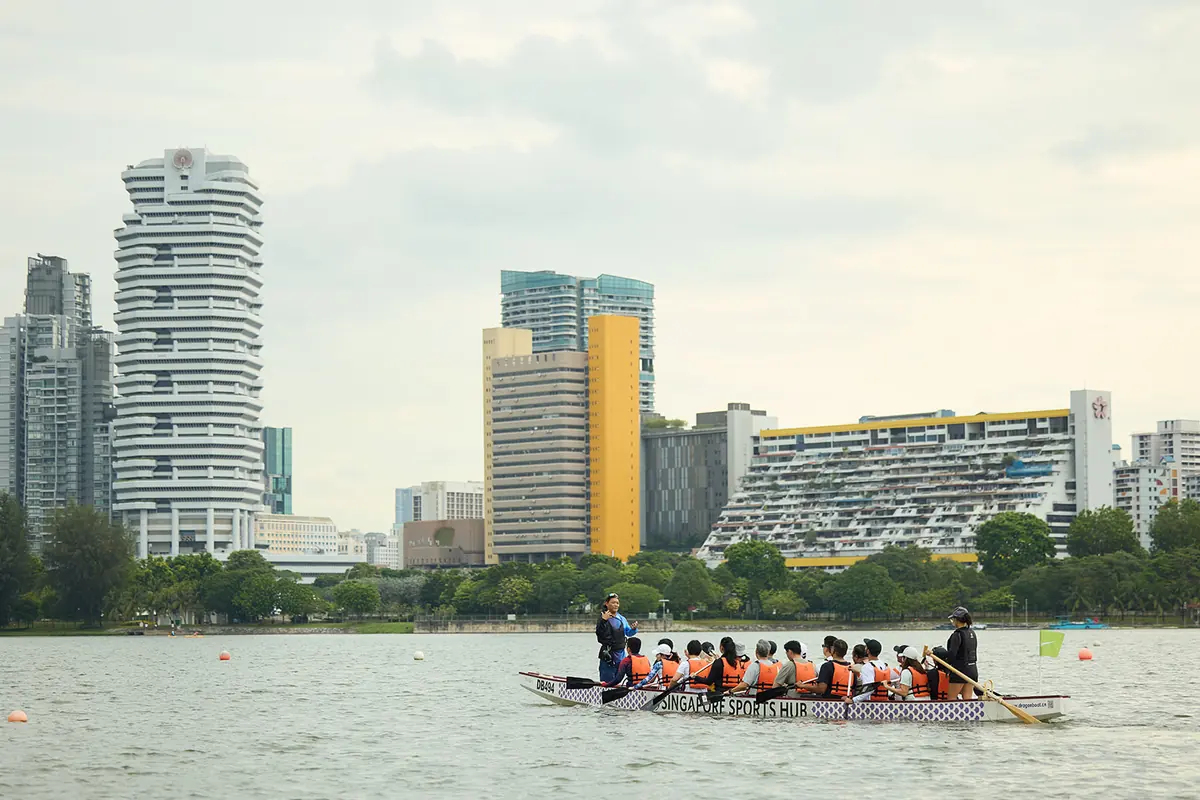
- Dragon boating. A whole crew paddling to one beat. The most demanding and the most exposed.
- Kayaking in pairs. Easier to start than a dragon boat, and pairs can go at their own pace.
- Stand-up paddleboarding. One board each, so it suits a small group with steady balance.
On a field
- Sports-day relays. Stations run in heats, and each leg can be walked or sprinted.
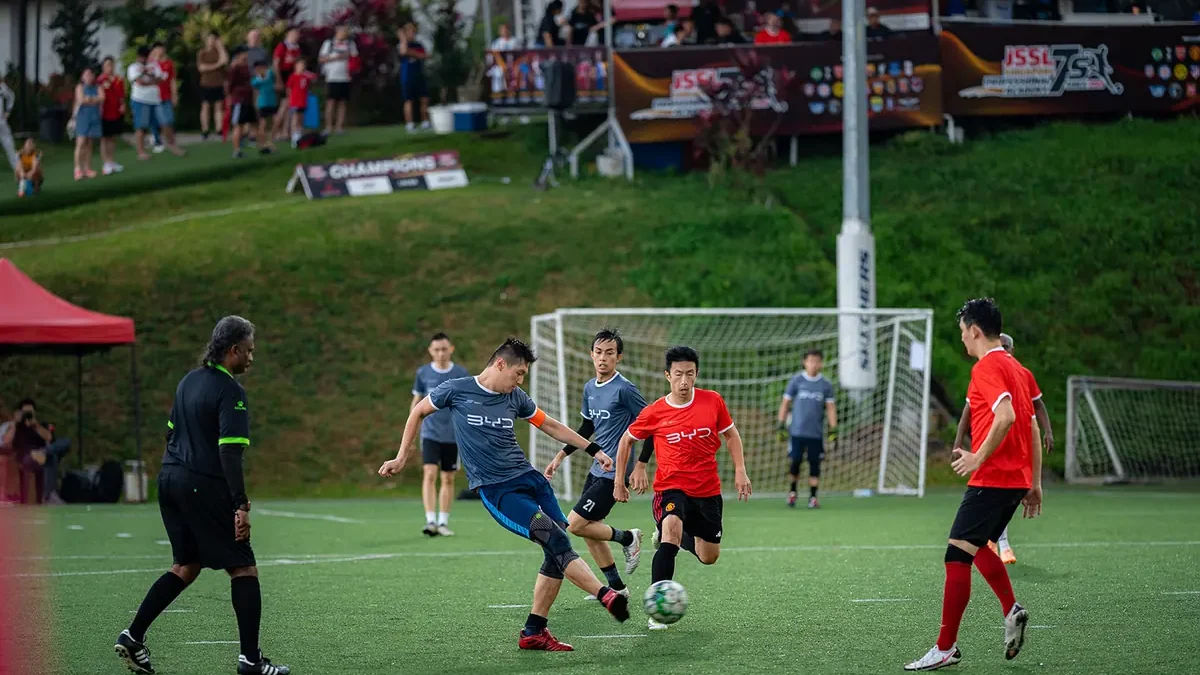
- A friendly football or futsal match. As the group grows, add pitches and keep the teams the same size.
- Tug of war. Over in a few minutes, and anyone can take hold of the rope.
- Archery tag or laser tag. Teams in the open with soft-tipped arrows or infrared, after a safety brief.
- Bubble soccer. Players inside inflatable bubbles. More laughter than football, and hot work by midday.
Along a trail
- An amazing race. Small teams solve tasks between checkpoints. The slowest format to bring in when a storm comes.
- Orienteering. Teams find markers in a park with a map, at walking pace.
- A photo hunt. Teams collect pictures of set items along a route. The lightest of the trail formats.
- A guided heritage walk. A neighbourhood and a guide who knows its stories. It suits a group that wants to talk.
On mats
- Group yoga or stretching. The lowest bar to take part, and under a roof in minutes.
- A guided circuit class. The same mats, for a fitter group that wants to work.
- Tai chi. Slow enough for every age in the company.
The outdoor day sorter
Three inputs, one starting format, and what the month is likely to throw at it. The season and lightning lines come from the national climate record (MSS, 1991 to 2020), not a forecast; the advice is ours.
Heat, shade and the time of day
The daytime maximum here usually sits between 31 and 33 degrees Celsius, and hot afternoons above 32 are common from late March to May. NEA's heat stress advisory goes further: it reads the wet bulb globe temperature, which counts humidity, wind and sun, and shows it on the myENV app. At moderate heat stress, 31 to 33, the advice is to cut back outdoor activity and take breaks in the shade. At 33 and above, keep it to a minimum. Check it that morning and put the most physical part of the day early.
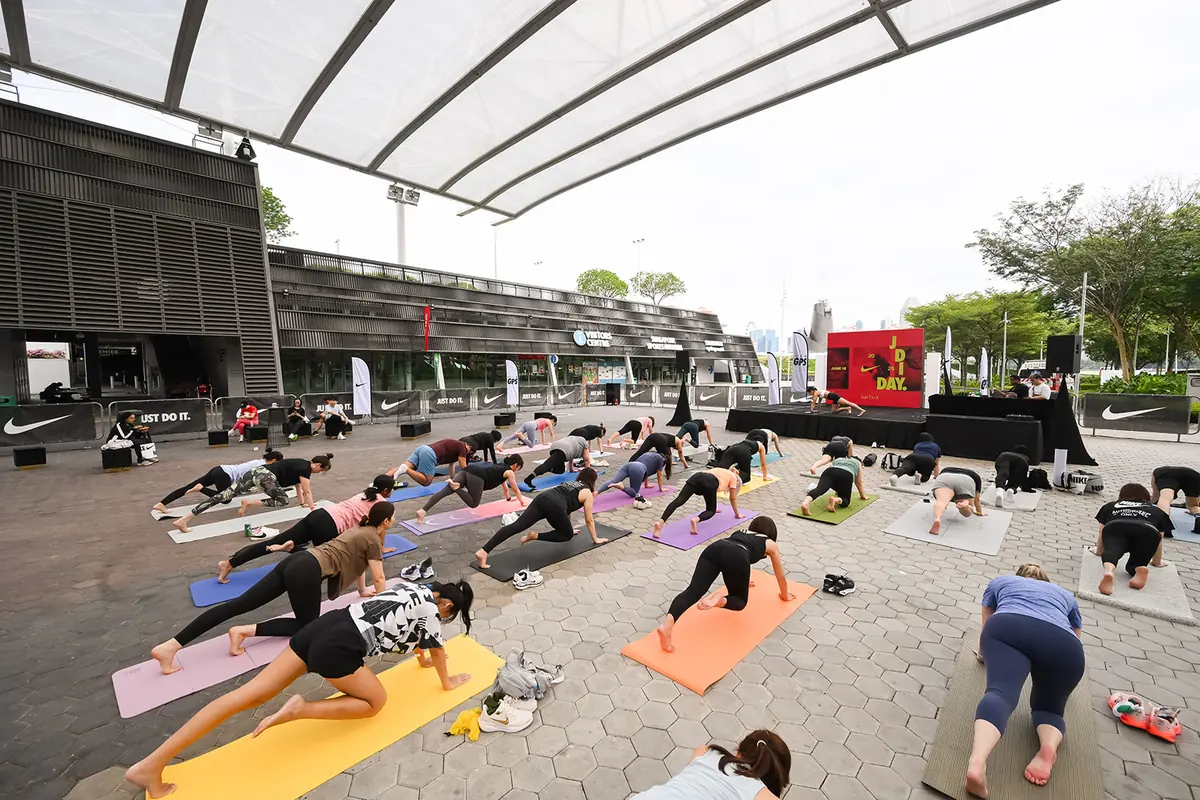
In a photograph from one outdoor mat session our team worked on, the mats ran in rows across a paved plaza, with shoes left on the paving beside them. A translucent roof reached over part of the group, and the rest of the rows ran past its edge into open sky. The sky that day was overcast. On a clear afternoon, that roof line decides who spends the hour in full sun. Lay out the shade first, then fit the group inside it.
The rain plan is a call time, not a covered area
Rain here keeps a calendar. The Meteorological Service Singapore's climate record puts the highest rainfall from November to January, the wet phase of the Northeast Monsoon, when monsoon surges can bring widespread, continuous moderate to heavy rain. In the two inter-monsoon periods, late March to May and October to November, thunderstorms build in the afternoon and early evening. From June to September, squalls can arrive between the early hours and midday.
November averages 22 days with lightning, the most of any month. February averages 4.
A shelter keeps people dry, but it rarely holds everyone, and it does not keep a boat on the water. The plan is a decision made in advance: who makes the call, when, and what happens next. Make one call the evening before from the forecast and a second that morning. The myENV app sends lightning alerts for a place you choose, within six kilometres by default or eight if you set it: a fair trigger for clearing the water and the field. From December to early January, when monsoon surges are most likely, book the indoor fallback outright. As with anything that goes wrong at an event, write the second option down while it still costs nothing.
Large groups outdoors
The bigger the group, the longer it takes to bring everyone under cover, so the fallback has to be close and has to fit everybody. Queues and transitions are covered in running team building for 100 people or more.
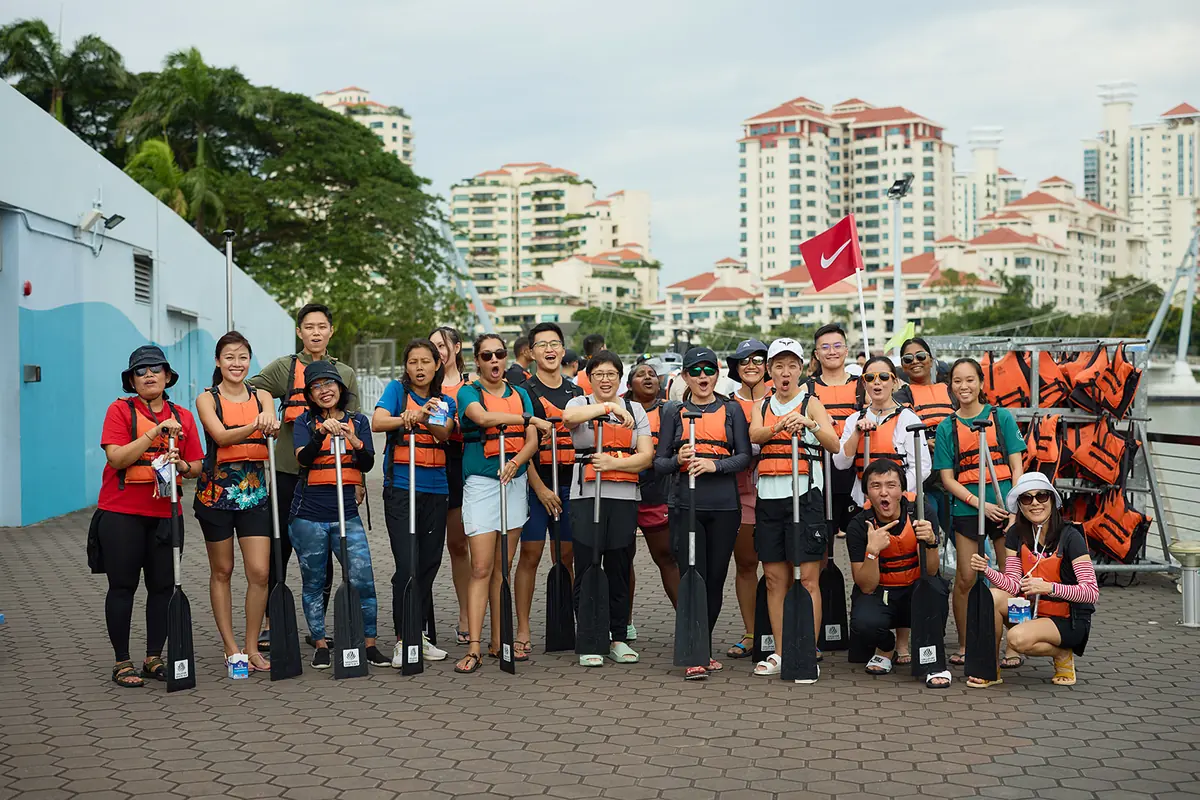
Kitting out takes its own time too. In one frame from a dragon boat session our team worked on, the crew stood at the waterside in buoyancy aids, most of them holding a paddle, with more jackets hanging on a rack behind them. Every paddler was already wearing one. At scale, fitting them is a queue, and it belongs in the timings with water points and toilets.
The weather plan decides whether the day happens. Whether it was worth having depends on the outcome it was chosen for. Our team building page sets out how we plan team days, and the work page shows team days our team has worked on.
Common questions
What are good outdoor team building activities in Singapore?
Dragon boating or kayaking on the water, relays, a friendly match or tug of war on a field, an amazing race or orienteering along a trail, and yoga or a guided class on mats cover most outdoor team days. Choose by the spread of fitness in the group and by how exposed the format is. A boat on open water has nowhere to shelter, while a mat session can move under a roof in minutes.
What happens to an outdoor team building day if it rains?
It should follow a decision made in advance: a named person, a call time, and a fallback that holds the whole group at once. Make one call the evening before from the forecast and a second that morning. From December to early January, when monsoon surges can bring continuous heavy rain, book the indoor fallback outright rather than holding it on standby. When lightning is detected nearby, the water and the open field are cleared first.
Does outdoor team building work for large groups?
Yes, if the format runs in parallel heats rather than one queue, and the plan covers what scale multiplies: kitting out, water points, toilets, and shade or shelter that holds everyone at the same time. The bigger the group, the longer it takes to bring everyone under cover, so the fallback has to be close and has to fit everybody.
Planning a team day outdoors
Tell us the headcount, the month and what should be different afterwards. We will come back with a format, a rain call and a fallback, and an itemised quote you can read.